
EDUCATION (PPSL)
Educational Sector
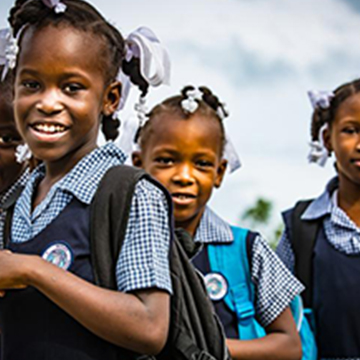
Haitian children will be taken care of by the Haitian state, from kindergarten to university. Haitian families will have NOTHING to pay. Books, shoes, uniforms and instructional materials will be provided free of charge to parents by the state. Two hot meals, in the morning and at noon from local products, will be offered free of charge
every day of class to Haitian children.
The Haitian government will do so, because it believes that Haitian youth represent the future of the country. By supporting the youth, the Haitian state prepares those who will pay the taxes of tomorrow to enrich the nation. It is an investment for the future. PPSL will spend $ 1 billion from the Education Fund, to build 10 universities / one in each department that can accommodate 15,000 students each; a high school of 5,000 students in each municipality, each accompanied by an industrial school campus and finally a primary-higher school
of 500 students in each of our approximately 600 rural sections.
If affective / emotional training is the business of the parents, educating the children of Haiti will become the business of the state. Thus, the Haitian state will invest in Haitian youth. He will take charge of the young Haitian in all areas from two years to twenty-four, the age at which he will have to
obtain a university degree and also hold a profession.
Each high school will have an average of 5,000 students. Although managed by the community where it is established, each high school will follow the same national curriculum. The competence of teachers will be the same in the capital as in the rural sections. A neat uniform (elegant designer designed white bodice and jeans) will be the same in all schools provided by the Haitian state. The new Haitian schoolboy will follow an academic program that will include, from kindergarten to high school, basic classes in Latin and Greek, as well as learning English, Spanish and French in addition to Creole. Creole will resume its writing with its Latin etymological root so that Haitian can easily assimilate Latin languages from Creole.
The program will also include compulsory ethics classes from kindergarten to university.
School will start at 7:00 am with lunch for all students. The instruction will begin at 8:00 am; There will be a lunch break and recreation at 12:00 p.m. and classes will resume at 1:30 p.m. and end at 4:30 p.m. Thus, the Haitian student will satisfy well beyond each year the 12 hours required to complete
the national and international school curriculum.
The State University of Haiti will have autonomous branches in each department of the Republic that can accommodate up to 15,000 students each. There will be no fees for Haitian students, except the registration fee of 1000 gourdes per semester. The total amount of these fees, doubled by the Haitian state, will be controlled, of course with the supervision of the Dean of Students, by the students themselves for artistic, leadership and athletic activities. The Haitian State will establish a Secretariat
from the state to the university administration which will be responsible for the renewal of higher education in Haiti.
The Haitian state in its policy of a good school for all will reverse the present mentality of "everything goes" of private schools. The government will also be keen to facilitate the recycling of private schools into tourist accommodation centers and other related purposes. Religious and private schools that accept the rigorous test of the Haitian state for excellence in education and the environment will be subsidized by the Haitian state,
so that an excellent education is accessible to all children, rich or poor.